
I’m a big reader. With a terrible memory.
I’m always reading something: as many as two or three books, magazines, the newspaper, other writers’ work in progress, the interwebs. I have stacks of torn-out articles that I promise myself I’ll get to. Sometimes I actually do.
As much as I love reading, and can be profoundly moved, laughingly entertained, schooled and enlightened, it all smushes together in my brain. I can tell you I loved it, but I have a harder time actually recalling what I read.
Sometimes I read something that makes me stop, reread and think, and I’m determined that I! shall! remember! Like these two pieces…
The first was Barbara Kingsolver writing about Wendell Berry after he passed away in August. These are two brilliant writers, national treasures, who care deeply about our earth so it’s no wonder that she wrote so movingly about not just who he was as a writer, but as a steward of the environment.
His poems hold the sacred in the palm of their hand. In service of what might be taken for simplicity, his logical currents are clear and complex; his essays contain multitudes. One of his most famous, “Why I Am Not Going to Buy a Computer,” challenges our devotion to technological fundamentalism – not because Berry was a Luddite, or failed to appreciate his wife, Tanya, as an editor, typist and invaluable partner. Nor did he oppose a tool that helps us do good work. Rather, he saw danger in the conviction that new things are always better than old things. (If you’re a mortal human, you might think on that.) He saw the waste of endlessly buying solutions to problems we don’t have, and tragedy in an elusive happiness built on constantly changing out our possessions and selves; a damaging doctrine for those who can’t afford it, and also for those who can.
Most of all, he had the rare vision to see a thing, any thing, not just at the moment of acquisition but through its whole passage from mineral extraction, the mess of manufacture and transport to the consumer and beyond, to the desecration we call “landfill.” He nudged us to do the same, and to have the courage to ask, “Is my need important enough to inflict this injury on the world?” He didn’t say do, or don’t. He just said to look. Widen your gaze, and look again.
The other piece was a Q&A with George Saunders that Andrew shared with me. In this age of AI, which endangers writers like me, not to mention all of humanity, I loved Saunders’s self-assured response. He’s so confident and direct, it makes me wonder why more people can’t speak about AI and creativity like this.
“Who are we ceding our authority to, exactly, when we let AI write for us? And why? Why surrender our agency (that amazing ability we have to reach across time and space, with our strange, idiosyncratic phenomenon, and land within the sensibility of another human being) to something that, by its very design, pushes the individual sensibility aside? And in the name of…what, exactly? Ease, I guess? Efficiency? The person who chooses to write with AI has also sacrificed from the start, the opportunity of experiencing difficulty, of struggling to say what he wants to say, of making himself evident in his prose, of trying to find out what he believe. By this, he sacrifices a chance to know himself and his mind better. To me, that’s a shame. And it’s dangerous, because, as we are now finding out, it affects the brain and lessens our capabilities. Thanks, but no thanks, get me behind me, etc.
The human mind can generate that ‘endless material’ and, what’s more, there’s something germinative and essential in one’s messy first draft—the mess the writer herself has made. There’s some flavor in there unique to that writer’s mind… Even in that very first draft, you, the writer, are in there, inextricably and importantly. I would never want to sacrifice that…”
When writing is good, when writer’s articulate their mission or vision like these two here, it makes me want to go back to my thirties when I was so passionate about writing, and more hopeful about the world. Taking solace in the wisdom and perspectives cultivated while reading now will have to do.
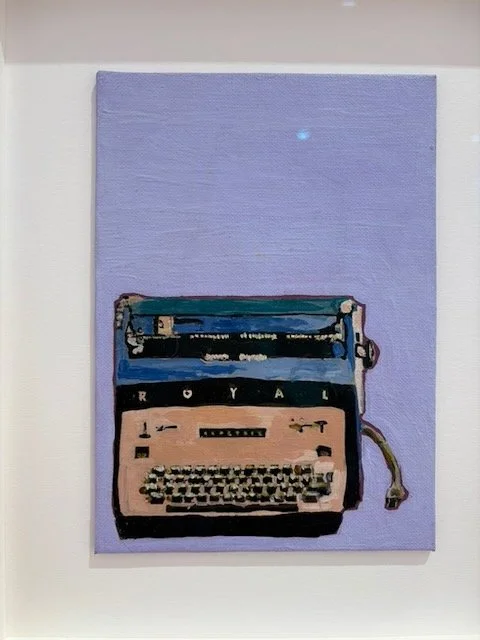
*Image is from another writer! Rosalyn Drexler was not only the painter of that beautiful typewriter but was also an author.