About 8am last Sunday morning, my phone started pinging.
“omg, hilarious and true”
“So funny! And spot on.”
“It’s [expletive] exactly true and hilarious and sad.”
In case you weren’t also pinged, all of these, and many other messages, were talking about Saturday Night Live’s “Sister” skit.
In the three-minute spoof, host and comedian John Mulaney explains how helpless he felt about his aging father and the limited options available for his care. Until he heard about… “Sister.” In one joke after another that land with hilarious (and depressing) accuracy, he extols the altruistic, reliable benefits of relying on Sister for parental caregiving, so “I can get back to my life!”
It’s true, caregiving leaves little time for pursuing, well, much of anything. It’s not like having a cool “side hustle.” There’s no joyous declaration of a “pivot” when you take on caregiving duties, or even a stoic sharing that this is something happening in your life. It’s one of the most overlooked and underappreciated roles with high levels of depression to go along with it.
We are midway through “National Caregivers Month,” a movement led by the Caregiver Action Network to advocate for the recognition of those who devote resources and support to family or friends with health needs. By CAN’s count, there are 63 million family caregivers in the US. I imagine they feel a constant sense of dread and overwhelm as I do.
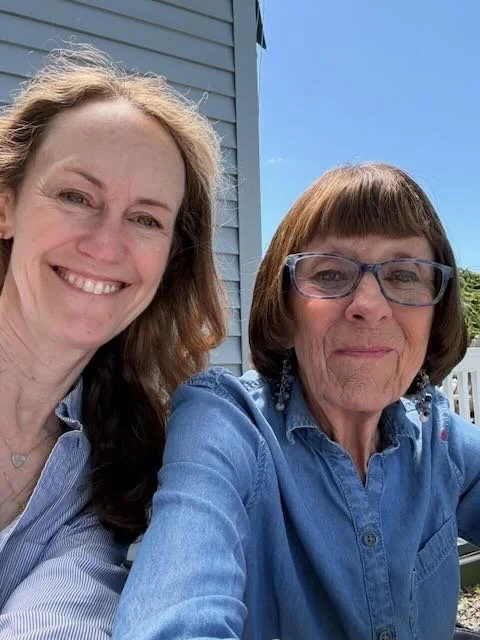
When my stepfather passed away three years ago, I automatically assumed responsibilities for my mom, who lives a town away from me. I helped organize her finances, started going to doctor visits with and coaxed her out the house to be social more often. Her father died of Alzheimer’s at the age of 83, in a nursing home, so I have long been bracing myself for this very experience I’m now living. I have witnessed her cognitive skills decline from “mild” to “moderate” impairment to a now borderline unsafe situation for her to be living alone. My husband and I are building an Accessory Dwelling Unit for her in our backyard.
Why did this SNL skit resonate with so many like me? The parody explains it best. “Here’s how it works: Years of internalized sexism warps Sister’s brain into thinking caretaking is her responsibility.”
I knew I was going to be the one taking care of my mom after my stepfather’s death. Even if my sibling, a brother, a brother who unironically was the first one to send me the skit, lived closer than 2,000 miles away, it would be me who was sweating her caloric intake, calling the insurance company and acting like her on-call IT expert (which, if you knew how tech-savvy I’m not, you’d recognize the hilarity in that).
Partly, I admit, it’s me. A Type A, I have a hard time sitting back. I’m a good planner, a practical thinker, and I like to be in control. I’ve also spent over a half a century afflicted with good girl syndrome, a learned behavior of accommodating other people’s needs before my own. But because the skit’s punchlines were equally gut punches, I realized how much we need to blow up gender norms.
Let’s start by refusing to reward young girls for taking care of others. Let’s refrain from calling them “sweet” and telling them to “play nice.” Instead let’s encourage them to speak loudly, play rough and go first.
Let’s do the same for boys and men. Let’s normalize male babysitters, teachers and nurses, support signs of sensitivity and stop fawning over dads who do dropoff. Let’s include husbands in housework and cooking—and maybe mixology and grilling don’t count.
This also means women need to stop valorizing our behavior. I admit to feeling a jolt of pride, eating up the emotional gold star, when someone remarks on my being a “good daughter” for spending so much time with my mom. I know I’m just as overly solicitous with my husband and daughter, seizing opportunities to do for them what they can do for themselves. Tomorrow, my 12-year-old butters her own bagel!
At the same time, let’s cut our elderly population some slack. As Lucy Schiller points out in her book Aging Out: An Exploration of Caregiving, Community and How Americans Grow Old, our culture has a barely concealed disdain for older people. Schiller wrote her book in part because she noticed an antagonistic sentiment as she took on care for her grandmother during the Covid pandemic. Rhetoric that has seeped into American culture, like calling the virus the “Boomer remover,” instills the idea that people are disposable once they reach a certain age.
The number of Americans 65 and older will more than double over the next 40 years, with the 85+ set nearly quadrupling. Chronic diseases such as dementia and Parkinson’s are also projected to increase, making a stronger support system for their care essential.
Caregiving is a crisis coming for all of us. We can’t continue to just rely on women to shoulder the burden.
Of course it’s not just on us as individuals and a culture to rectify a broken system. There are so many structural issues to fix, from underfunded and understaffed nursing homes to private equity driving up costs to inadequate housing and care options to begin with. But these legislative issues somehow seem easier to change than our own learned behaviors.
This Saturday Night Live skit lit up my phone and the internet. The video on YouTube received two million views within 24 hours. I, along with countless other female caregivers, most who are shouldering greater burdens with fewer resources than I am, laughed, rolled our eyes, and suppressed our rage. It was three minutes that made us finally feel seen. Which is the greatest joke of all.
If you’re still reading, thank you. I pitched this op-ed to six pubs, and no bites. Rather than adding it to my written-but-never-published folder, I figured I’d share it here. I mean, who didn’t see the skit? Who didn’t it resonate with? I’m glad to see there was such a big response to it. The challenge really, is what do we do about it.